

Dallas landscaping companies can improve local visibility and generate more leads by fixing weak Google Business Profile, service pages, location pages, technical SEO, reviews, internal linking, and lead-tracking issues.
A landscaping company can do excellent work and still struggle to get calls from Google. The problem often starts with small SEO issues: an incomplete Google Business Profile, generic service pages, weak location signals, slow mobile pages, or content that does not match what Dallas homeowners actually search for.
The solution is a focused local SEO system. Your website, Google Business Profile, service pages, reviews, local citations, and links should all help Google understand what you do, where you work, and which searches your business can satisfy.
This guide covers the most common landscaping SEO mistakes Dallas companies make, why they happen, and how to fix them without turning your website into a pile of repeated city names.
What You’ll Learn
- The 10 SEO mistakes that can limit local visibility.
- How to improve your Google Business Profile.
- How to match landscaping pages with search intent.
- When service and location pages make sense.
- How to avoid thin and duplicate content.
- How reviews, citations, and local links support trust.
- Which technical SEO problems deserve attention?
- How to connect your pages with internal links.
- Why leads matter more than rankings alone.
- A practical Dallas landscaping SEO audit checklist.
10 Landscaping SEO Mistakes Dallas Companies Should Avoid
Dallas landscaping companies compete for customers across different services, neighborhoods, and search types. That makes a clear local SEO structure especially important.
Below are 10 problems we commonly look for when reviewing a landscaping website, along with practical ways to fix them.
#Mistake 1: Treating Google Business Profile as a Set-It-and-Forget-It Listing
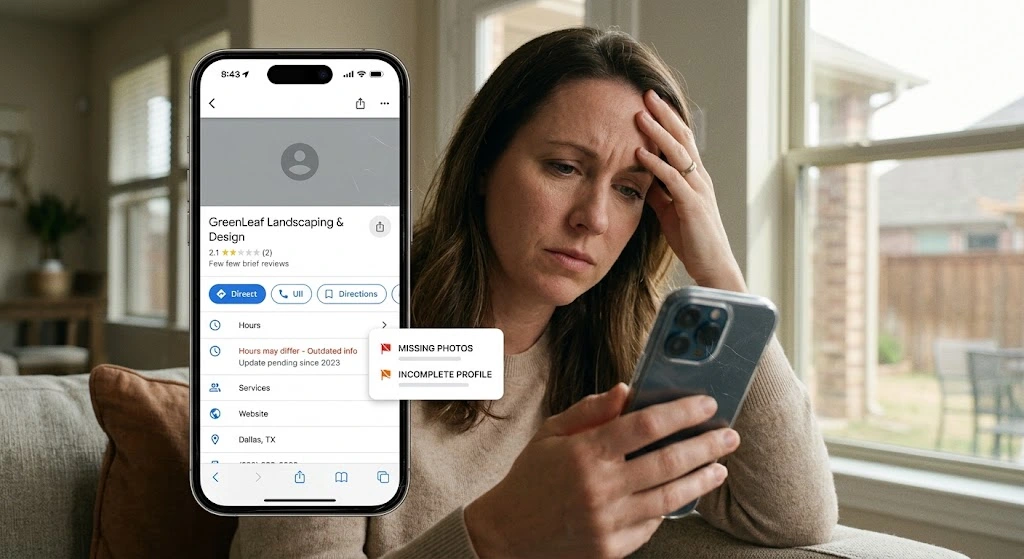
Your Google Business Profile is often one of the first places a potential customer encounters your company. For a service-area landscaper, an accurate and complete profile helps explain what you do and where you serve.
Why It Matters
Google says local results are mainly based on relevance, distance, and prominence. Complete and accurate business information helps Google understand whether a business matches a local search.
A common problem is creating the profile once and rarely reviewing it again.
Imagine a Dallas landscaping company that offers lawn maintenance, irrigation, drainage, sod installation, and landscape design. Its profile lists only a basic category and an old phone number.
The website may be excellent. The profile still gives Google and customers limited information.
Google also says Business Profile information can come from multiple sources, including the business website, third-party data, users, and business owners.
How to Fix It
Review your profile regularly.
Check:
- Business name.
- Primary category.
- Services.
- Phone number.
- Website.
- Business hours.
- Service area.
- Business description.
- Photos and videos.
- Customer reviews and responses.
Keep the information accurate. Do not add keywords to the real business name just to rank. Google requires businesses to represent their real-world name accurately.
For service-area landscapers, make the service area match the places you actually serve. Google allows service areas based on cities, postal codes, or other defined areas rather than a radius.
#Mistake 2: Targeting “Landscaping” Instead of the Search Intent Behind It
People looking for landscaping services are rarely searching for the same thing. One homeowner may need weekly lawn care, while another needs drainage work after repeated standing water.
Your SEO strategy should reflect those different needs rather than forcing every search into a single broad keyword.
Why It Matters
“Landscaping” is broad.
A homeowner searching for “landscape design Dallas” has a different need from someone searching for “sod installation near me.”
The same applies to:
- Lawn maintenance.
- Irrigation repair.
- Drainage solutions.
- Mulch installation.
- Tree trimming.
- Yard cleanup.
- Hardscaping.
- Outdoor living.
If every page targets the same broad term, your website gives Google fewer clues about which page should answer each search.
How to Fix It
Start with the problem behind the search.
For example:
| Search intent | Better page focus |
| Needs regular lawn care | Lawn maintenance |
| Wants a new yard design | Landscape design |
| Has standing water | Yard drainage |
| Needs new grass | Sod installation |
| Wants outdoor features | Hardscaping |
| Needs sprinkler work | Irrigation |
| Needs seasonal cleanup | Yard cleanup |
Then connect those services to real demand in the Dallas area.
For a deeper framework, see our guide to landscaping SEO in Dallas.
#Mistake 3: Putting Every Landscaping Service on One Generic Services Page
A landscaping company may offer a long list of services, but putting everything on one page can make it difficult for customers and search engines to understand each offering.
When a service has its own search intent and customer problem, it often deserves enough space to explain that service properly.
Why It Matters
A single page titled “Landscaping Services” can be too broad for a company offering many different services.
Think about the customer journey.
Someone searching for “drainage contractor Dallas” wants information about drainage problems. They do not want to scroll through five paragraphs about mowing before finding what they need.
A dedicated service page gives you room to explain the specific problem, service, process, location, proof, and next step.
How to Fix It
Create dedicated pages when the service has meaningful search demand and a distinct customer need.
A strong service page can include:
- What the service solves.
- Who needs it?
- What the process involves.
- Areas served.
- Local conditions.
- Project examples.
- Frequently asked questions.
- Reviews or testimonials.
- Clear estimate or consultation CTA.
For example, a Dallas drainage page could discuss standing water, poor yard grading, heavy rain, soil conditions, and drainage solutions.
That is much more useful than repeating “best landscaping company in Dallas” throughout the page.
#Mistake 4: Creating Thin or Duplicate Dallas Service-Area Pages
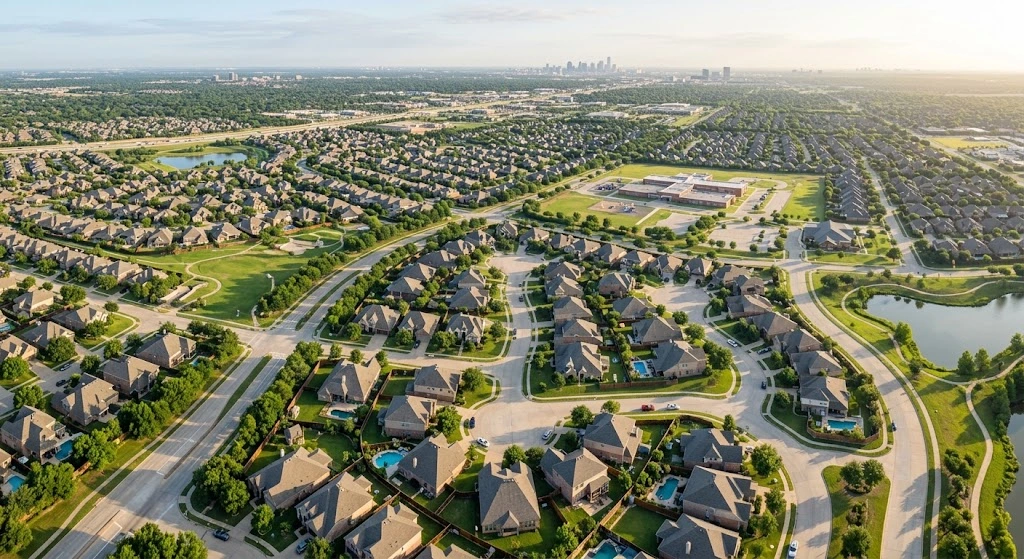
Service-area pages can help a landscaping company explain where it works. Problems begin when a website creates dozens of pages that say almost the same thing.
A useful location page should give someone in that area a reason to stay, read, and contact the company.
Why It Matters
This is one of the easiest traps for a local landscaping website.
A company creates:
- Landscaping Dallas.
- Landscaping Plano.
- Landscaping Frisco.
- Landscaping McKinney.
- Landscaping Allen.
Then, it changes only the city name.
You now have several pages that provide almost the same information.
That does little for users. It also gives search engines weak evidence that each location deserves its own page.
How to Fix It
Only create a location page when you can make it genuinely useful.
A useful service-area page might include:
- Services actually offered there.
- Local project examples.
- Neighborhoods served.
- Local customer questions.
- Relevant photos.
- Service considerations.
- Reviews from that area, when legitimately available.
- Links to related services.
For example, a page targeting Frisco should have useful Frisco-specific information. Swapping “Dallas” for “Frisco” throughout the same template is not a local SEO strategy.
Your Google Business Profile should also reflect the areas you actually serve. Google recommends accurate and specific service-area information for service-area businesses.
#Mistake 5: Weak Titles, H1s, Meta Descriptions, and On-Page Signals
A search engine needs clear signals about what each page covers. Customers need the same thing.
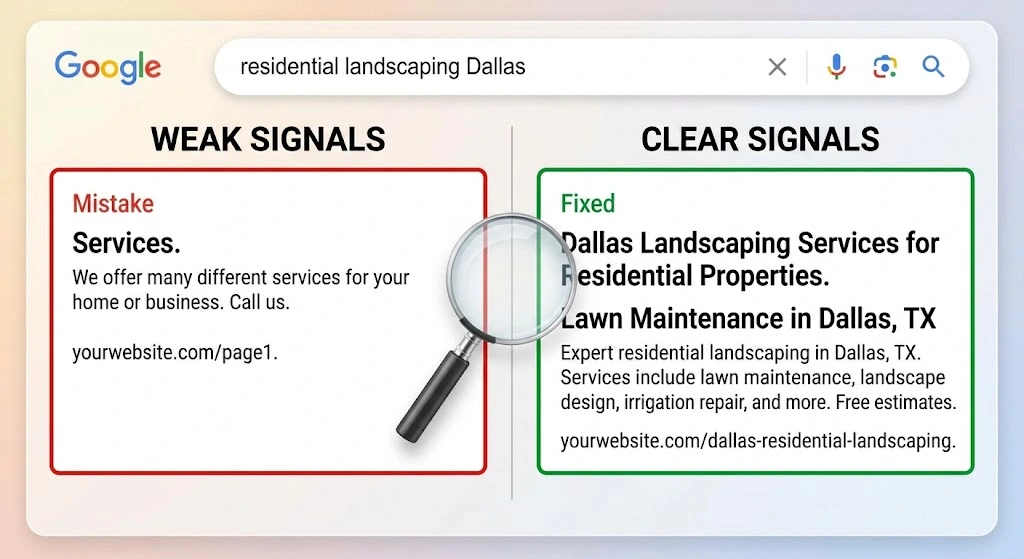
When titles and headings are vague, you miss a simple opportunity to make the page topic obvious.
Why It Matters
Your page title and headings help users and search engines understand the page.
A landscaping website might have a page titled: “Services”.
That title says almost nothing.
A clearer version could be: “Dallas Landscaping Services for Residential Properties”.
The same principle applies to H1 headings, image descriptions, page copy, and internal links.
How to Fix It
Give every important page a clear topic.
For example:
Title: Dallas Lawn Maintenance Services
H1: Lawn Maintenance in Dallas, TX
Supporting topics: mowing, edging, seasonal care, lawn health, service areas, estimates
Keep the wording natural.
Google’s Search documentation explains that structured data can help Google understand page content and may support certain search features when implemented correctly.
The goal is clarity. Your page should make sense before you worry about adding another keyword.
#Mistake 6: Ignoring Local Citations, Reviews, and Business Trust Signals
Local customers want evidence that a landscaping company is real, active, and experienced. Search engines also use information from different sources to understand local businesses.
That makes consistency and genuine customer feedback important parts of a local SEO foundation.

Why It Matters
Google gathers business information from several sources, including websites, third-party data, user contributions, and business owners.
That means your business information should tell the same story across the web.
If your website says one phone number while an old directory shows another, you have created unnecessary confusion.
Reviews matter for customers too. They show recent experiences and give homeowners evidence that your company actually completes the work it advertises.
Google also states that prominence can be influenced by information such as links from other websites and the number of reviews a business has.
How to Fix It
Audit important business listings for:
- Business name.
- Address.
- Phone number.
- Website.
- Business category.
- Service information.
Then build a simple review process.
After completing a landscaping project, ask the customer for an honest review. Respond to reviews professionally and address real concerns when appropriate.
Google recommends responding to reviews and adding relevant photos and videos to your Business Profile.
Avoid buying reviews or creating fake customer experiences. Trust is much harder to repair than it is to build.
#Mistake 7: Letting Technical SEO Block Your Landscaping Website
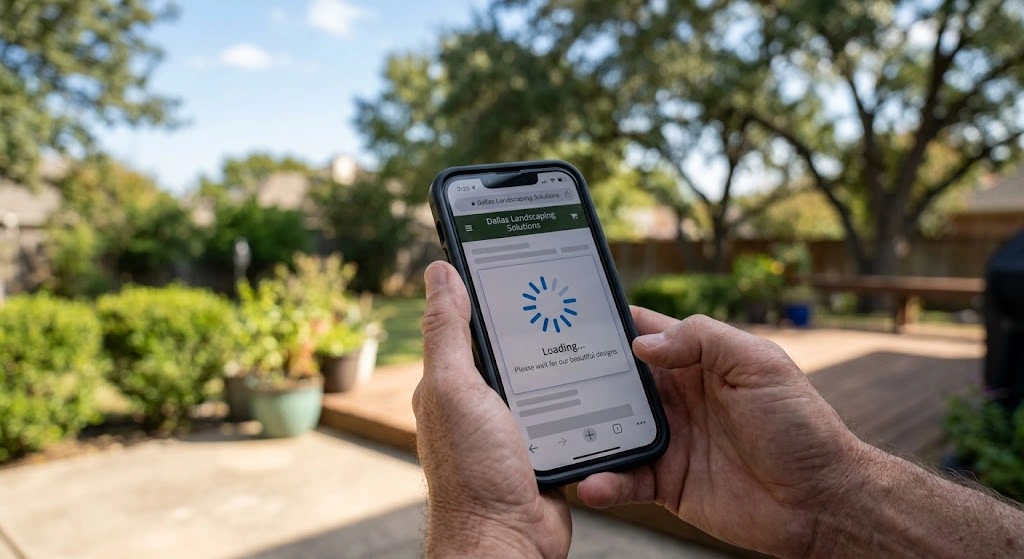
Technical SEO is easy to ignore when a website looks good on the surface. A page can look perfect to a business owner while still creating problems for search engines or mobile visitors.
For landscaping companies, technical issues can also affect the moment when a potential customer is ready to request an estimate.
Why It Matters
A beautiful landscaping website can still have technical problems.
Common examples include:
- Broken links.
- Missing pages.
- Poor mobile usability.
- Incorrect redirects.
- Indexing problems.
- Missing or poorly configured sitemap.
- HTTPS issues.
- Forms that fail.
- Pages that are difficult to crawl.
These problems can affect both search visibility and the customer experience.
Imagine a homeowner clicks your Google result, waits for the page to load, and then discovers the estimate form does not work.
You did not lose that lead because your landscaping service was bad. You lost it because the website got in the way.
How to Fix It
Use Google Search Console to monitor indexing and search performance.
Check your website regularly for:
- Important pages are being indexed.
- Broken links.
- Redirect problems.
- Mobile usability.
- Slow or heavy pages.
- Missing titles and headings.
- Form and phone functionality.
Technical SEO should support your local strategy rather than become a separate project that never ends.
#Mistake 8: Using Beautiful Landscaping Photos That Make the Website Slow
Landscaping websites need strong visuals. Project photos can show artistry far better than generic stock images.
The problem comes when high-resolution images are uploaded without proper optimization.

Why It Matters
Landscaping is visual.
You need photos showing patios, lawns, plantings, drainage work, retaining walls, irrigation systems, and completed projects.
The problem starts when every image is uploaded at a huge file size.
A gallery full of oversized images can make pages heavier than necessary, especially on mobile connections.
How to Fix It
Before uploading project photos:
- Resize images to the display size you actually need.
- Compress them.
- Use modern image formats when appropriate.
- Add useful alternative text.
- Avoid uploading multiple copies of the same image.
- Lazy-load images that are below the initial screen when appropriate.
Use real project photos whenever possible.
A photo showing a completed drainage project in Dallas tells a stronger story than a generic stock image of a perfect lawn.
Your images should support the page topic and the customer’s decision.
#Mistake 9: Building a Website With No Internal Linking Strategy
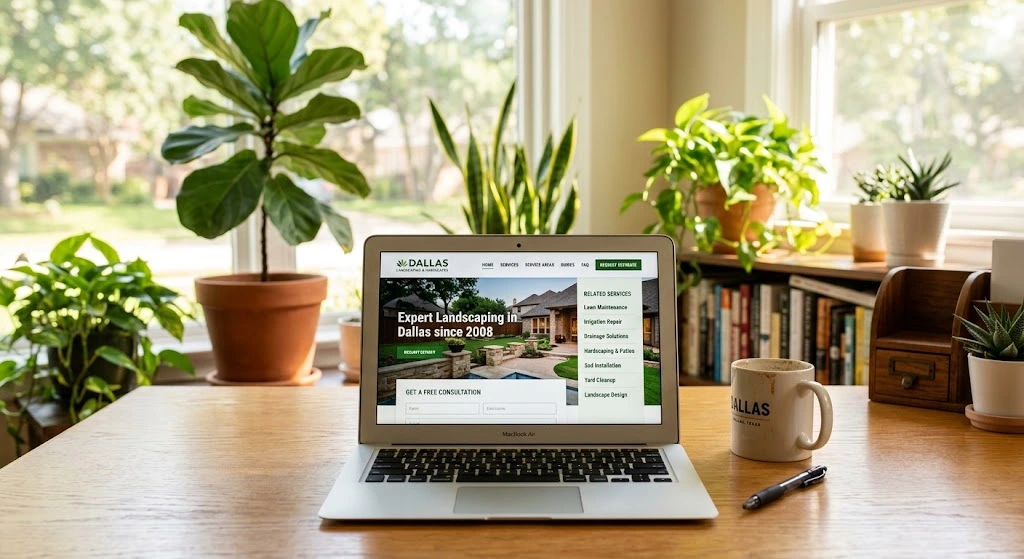
A landscaping website can contain excellent pages and still feel disconnected. Internal links create paths between related services, locations, guides, and supporting content.
They also help visitors find the next useful page rather than reaching a dead end.
Why It Matters
Internal links help users move between related pages.
They also help search engines understand how your content fits together.
Consider a landscaping website with these pages:
- Landscaping SEO.
- Lawn maintenance.
- Irrigation.
- Drainage.
- Landscape design.
- Local SEO guide.
- Customer lead guide.
If every page stands alone, you waste opportunities to connect related information.
How to Fix It
Build clear topical relationships.
For example:
Landscaping SEO guide → service pages.
Service pages → related educational articles.
Educational articles → relevant service pages.
Location pages → services actually offered in that area.
Use descriptive anchor text.
Instead of: “Click here”.
Write: “Dallas lawn maintenance services”. Or: “local SEO for landscapers”.
The link should tell the reader what they will find when they click.
This is also where your content hub becomes valuable. Your broader guide can support individual mistakes, service, and lead-generation articles without forcing unrelated links into every paragraph.
#Mistake 10: Measuring Rankings Instead of Landscaping Leads
Rankings are useful SEO data, but they are only one part of the business picture.
A landscaping company ultimately needs qualified opportunities, estimate requests, phone calls, and booked work.
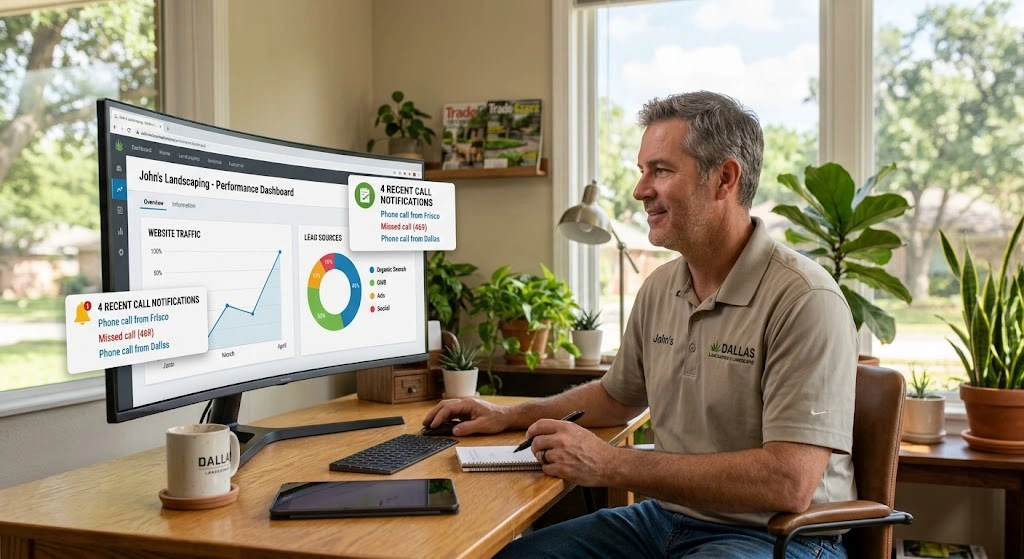
Why It Matters
A ranking report can look impressive while the phone stays quiet.
For a landscaping company, the business outcome matters.
You need to know whether organic search and local visibility are producing actions such as:
- Phone calls.
- Estimate requests.
- Contact forms.
- Consultation requests.
- Direction requests.
- Qualified leads.
- Booked jobs.
A position report alone cannot answer those questions.
How to Fix It
Connect SEO reporting with business activity.
Track useful signals through tools such as Google Search Console, Google Analytics, call tracking, and form analytics.
Look for patterns.
For example:
A service page receives more organic traffic → visitors contact the company → qualified estimates increase.
That tells you far more than simply saying, “The page moved from position 12 to position 8.”
For more context on turning local search visibility into actual opportunities, see our guide to getting more landscaping leads in Dallas.
Which Landscaping SEO Problems Should You Fix First?
You do not need to repair 100 SEO issues on Monday morning.
Start with the problems closest to revenue and fix the foundation before adding more pages.
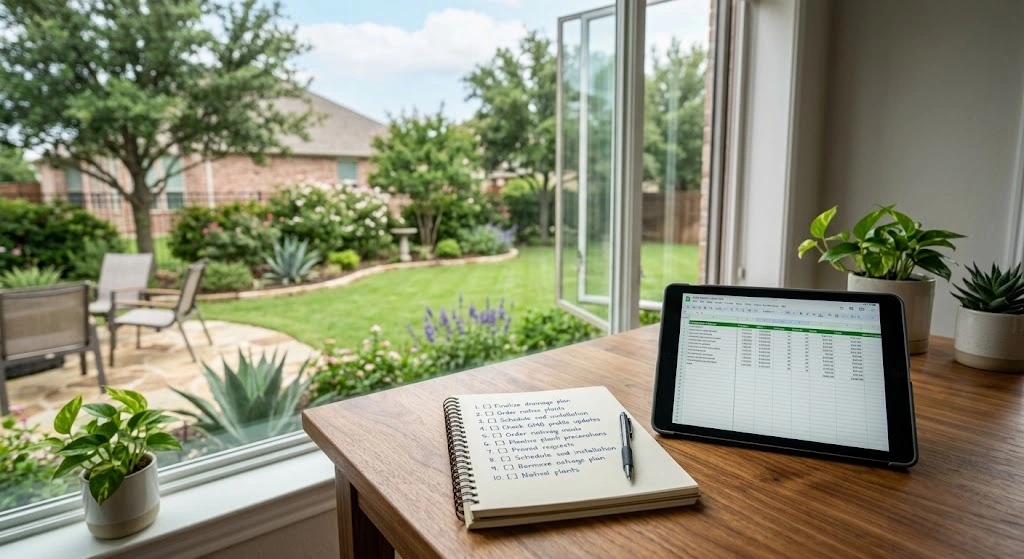
Start With the Foundation
First, make sure Google and customers can understand your business.
Check:
- Google Business Profile.
- Business information.
- Service area.
- Website accessibility.
- Mobile experience.
- Indexing.
- Main service pages.
Build Local Relevance
Next, make the site useful for the places and services you actually target.
Build:
- Dedicated service pages.
- Useful location pages.
- Local content.
- Relevant internal links.
- Accurate citations.
- Genuine customer reviews.
Build Authority and Conversion Paths
Finally, strengthen trust.
Use:
- Real project photos.
- Customer reviews.
- Local backlinks.
- Helpful content.
- Case studies.
- Clear calls to action.
- Lead tracking.
This creates a stronger connection between visibility and revenue.
Quick Dallas Landscaping SEO Audit Checklist
Use this checklist before starting another blog post.
| Search intent | Better page focus |
| Needs regular lawn care | Lawn maintenance |
| Wants a new yard design | Landscape design |
| Has standing water | Yard drainage |
| Needs new grass | Sod installation |
| Wants outdoor features | Hardscaping |
| Needs sprinkler work | Irrigation |
| Needs seasonal cleanup | Yard cleanup |
If several boxes are unchecked, fix those before publishing another 20 thin location pages.
Need Help Fixing Landscaping SEO Problems in Dallas?
Landscaping SEO works best when the strategy reflects the actual business.
A Dallas landscaping contractor offering irrigation, drainage, lawn maintenance, landscape design, and hardscaping needs a different content structure from a company that only provides mowing.
At Dallas Landscaping SEO, our approach focuses specifically on landscaping companies serving the Dallas-Fort Worth market. That means looking at service areas, Google Business Profile visibility, local search intent, website structure, content, AI search visibility, and lead tracking as interconnected parts of a single system.
If you are comparing providers, look for a team that can explain exactly how it will improve your service pages, local visibility, technical foundation, and lead-generation path. You can also review our Dallas landscaping SEO companies guide when researching your options.
Conclusion: Fix the SEO Problems That Affect Local Customers
The biggest landscaping SEO problems are often practical.
Your Google Business Profile may be incomplete. Your service pages may be too broad. Your location pages may look almost identical. Your website may be slow on a phone. Your reviews may be unmanaged. Your reporting may focus on rankings while ignoring leads.
Fix those issues in the right order.
Start with accurate business information and a strong local foundation. Build useful service and location pages. Connect related content with internal links. Improve technical performance. Add genuine proof through reviews and project work. Then measure what happens after people find you.
For a Dallas landscaping company, the goal is simple: help the right homeowner find the right service and make it easy to request an estimate.
FAQ
What is the biggest SEO mistake landscaping companies make?
A common mistake is treating SEO as a collection of keywords instead of a system built around customer needs. A landscaping website should clearly explain its services, service areas, expertise, and proof while making important pages easy for search engines and customers to find.
Why isn’t my landscaping company showing on Google Maps?
Several factors can affect local visibility, including relevance, distance, prominence, and the accuracy and completeness of your Business Profile. Check your business information, category, services, service area, reviews, website, and other local signals before assuming you need more backlinks.
Should a landscaping company create a page for every Dallas suburb?
Only when the page provides useful information for that location. A city-name swap creates little value. A strong location page should explain relevant services, local needs, project experience, and other information that helps customers in that area.
Do landscaping companies need separate pages for each service?
Important services often deserve their own pages when they have distinct customer needs and search intent. For example, drainage, irrigation, sod installation, lawn maintenance, and landscape design can each answer different questions and lead to different types of projects.
Do Google Reviews help landscaping SEO?
Reviews are an important part of a local business’s online presence. Google states that prominence can include information such as links to a business and its review count, while reviews also give customers useful information when comparing local businesses.
How can I improve my landscaping website for local search?
Start with accurate business information, useful service pages, relevant location content, strong internal linking, mobile performance, technical accessibility, customer reviews, local citations, and genuine project evidence. Each element should help Google and customers understand the business.
How long does landscaping SEO take to work in Dallas?
There is no reliable fixed timeline. Results depend on the site’s current condition, competition, content quality, local authority, technical issues, and the consistency of the work. Track changes in visibility, traffic, calls, forms, and qualified leads rather than relying on a single ranking date.
How much does landscaping SEO cost per month in Dallas?
Dallas Landscaping SEO programs cost $1,550 to $3,490 per month. Multi-location companies receive custom pricing. Ahrefs lists $1,557 as the average local SEO retainer.